
Advanced Ternary Pumped Storage Hydropower Enters Mainstream Grid Planning
New Vendor-Neutral Model Quantifies Grid Value of Ternary Pumped Storage Hydropower

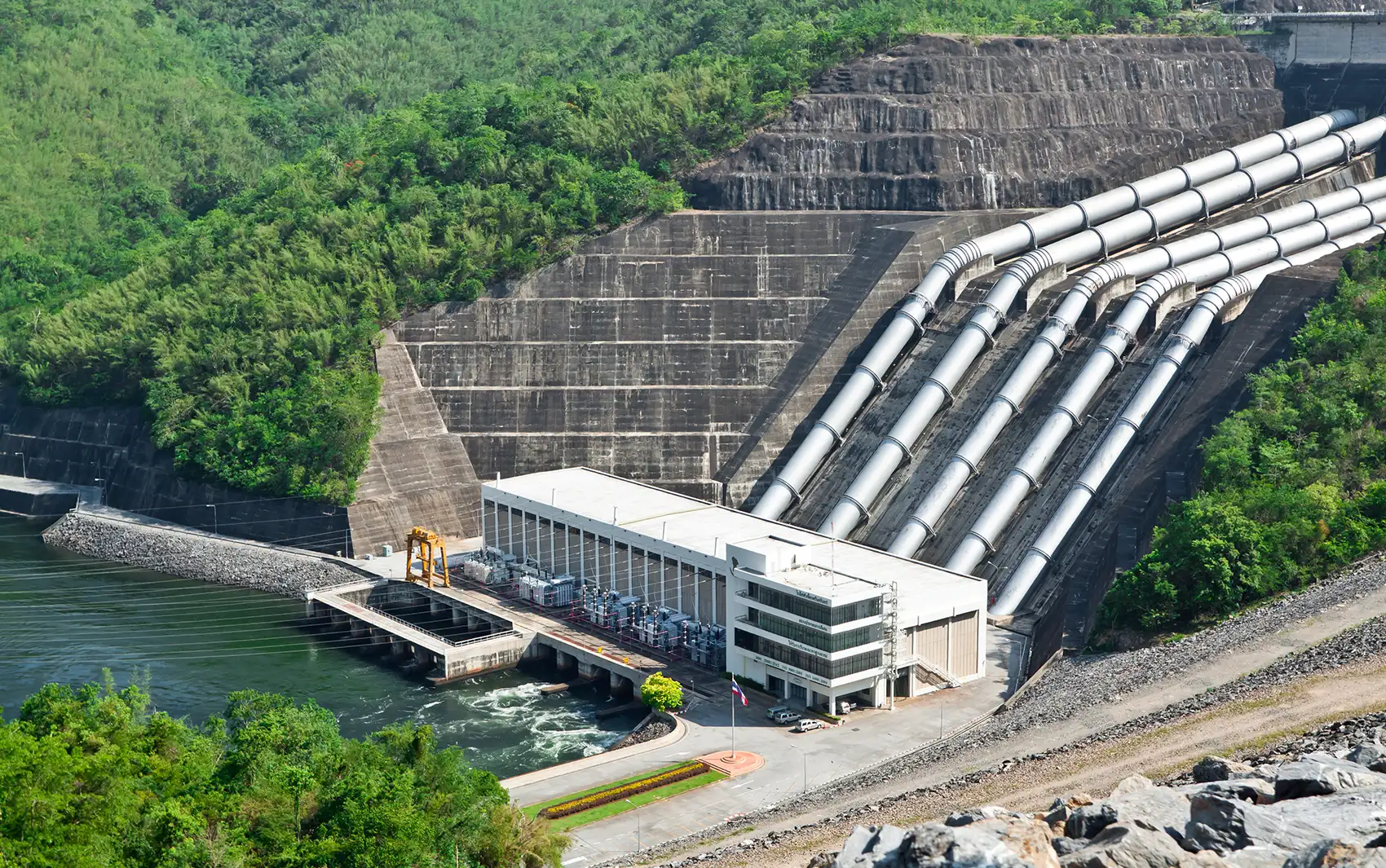
Across the United States and around the world, most energy storage is just water and gravity.The century-old method of pumped storage hydropower moves water uphill where it is stored until energy is needed, then releases it downhill to generate electricity.
A more modern version, called ternary pumped storage hydropower (T-PSH), acts as a battery that can charge and discharge simultaneously: it can pump water up and release water down to spin a turbine at the same time. This ability allows T-PSH to provide rapid-response grid services, whether using or generating electricity.
To expand the value and versatility of the United States’ PSH fleet, researchers at the National Laboratory of the Rockies (NLR), in collaboration with GE, Absaroka Energy, and Auburn University, delivered a vendor-neutral model for T-PSH plants that anyone across industry can use for commissioning, planning, and studying interconnection.
NLR’s model specification of T-PSH is approved for use by the Western Electric Coordinating Council Modeling Validation Subcommittee and will be implemented by all major power simulation software providers.
This new T-PSH model allows utilities and companies to rigorously check feasibility of new interconnections and demonstrate value for an advanced technology, leveraging the electromechanical properties that exist in live T-PSH systems.
“For the first time, utilities can consistently evaluate the reliability and stability benefits of ternary pumped storage hydro using industry-standard planning tools,” said Jin Tan, chief engineer at NLR. “This provides the technical foundation needed to quantify its value, compare alternative technologies, and support future investment decisions from a perspective of power system needs.”
What Does Ternary Pumped Storage Offer the Grid?
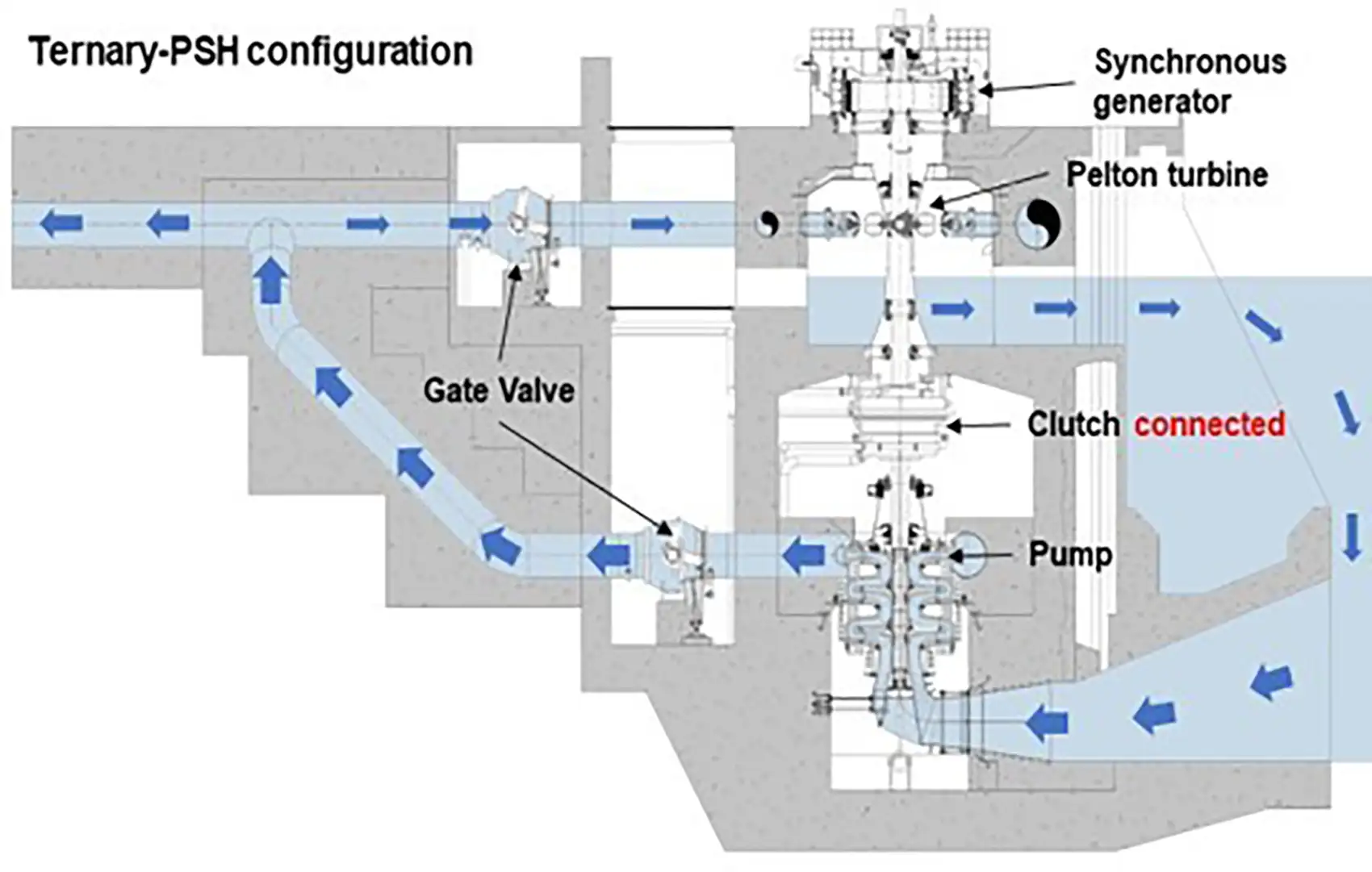
A T-PSH system is a configuration of pumped storage that separates the pump and turbine on the same shaft with a clutch while allowing water to flow between the pump and turbine in a “hydraulic short-circuit.” The clutch allows both the pump and turbine to operate at the same time, as shown in the figure.
This design—three parts on the same shaft, all spinning in the same direction—allows T-PSH to transition quickly between pumping and generating modes or combine the two modes. Compare this to a conventional PSH system, which must physically stop and reverse direction to change between pumping and generating. The fast-switching means that T-PSH can inject or consume grid power rapidly, depending on the grid’s needs.
“T-PSH has the benefits of fast, flexible switching between pumping and generation,” said Zerui Dong, developer of the T-PSH model. “This means it can provide adjustable grid support functions such as inertia and frequency control with greater continuity and smoothness, which are needed for our future inverter-based-resource-rich power systems.”
For example, when the grid suddenly loses a generator and the system frequency drops below the normal 60 hertz, conventional PSH would simply stop pumping to reduce energy draw from the grid. But T-PSH could respond by reducing its pumping and simultaneously increasing its generation to provide additional grid capacity. It acts as fast-frequency response and spinning reserves, all within a single unit.
Until now, the electric industry has struggled to value these unique benefits in system planning.
The Importance of a Model
NLR's model provides a standardized way to represent T-PSH in grid planning studies. By capturing the technology's key electrical and mechanical characteristics, the model allows utilities, developers, and system planners to evaluate its performance and potential grid benefits using the same tools employed for other generation and storage technologies.
“The challenge in developing T-PSH is not a lack of interest in the underlying technology but rather a lack of a common model in the existing commercial power system transient simulation software for evaluating it,” Tan said. “Grid planners could identify potential pumped hydro projects, but it was difficult to quantify how much grid-support capability might be needed in a particular system.”
In other words, the power industry lacked a common language to plan for T-PSH. The new model provides the language to translate grid support questions into a simulation environment.
“Standardized models like ours provide a common framework for evaluating T-PSH technologies,” Tan said. “They help developers assess potential project benefits and help utilities and grid planners identify the capabilities that may be valuable to the power system. By enabling both groups to evaluate T-PSH using consistent assumptions, the model supports more informed planning and investment decisions.”
Up Next
With NLR’s T-PSH model now available and in use, the hydropower industry can more effectively evaluate the potential value of interconnecting T-PSH projects to the grid. Meanwhile, NLR continues to work closely with GE and other industry partners to develop and validate vendor-neutral generic models for advanced pumped storage hydropower technologies, including doubly fed induction generator-based pumped hydro. These models will be evaluated under representative operating and grid conditions to support planning, interconnection studies, and commissioning testing for power grids.
This work was funded by the U.S. Department of Energy’s Hydropower and Hydrokinetic Office (H2O). To work with NLR’s researchers for advanced pumped storage hydropower technology modeling and validation, contact Jin Tan at jin.tan@nlr.gov.
Last Updated April 28, 2026