
Researchers at National Laboratory of the Rockies Uncover Natural Design Laws That Shape Tree Cell Walls
Cell Wall Architecture Is Conserved Across Poplar Tree Populations—and That Could Speed Up Future Bio-Based Product Research

NLR researchers have demonstrated that cell wall architecture is conserved across 13 different poplar tree genotypes—a finding that could streamline future biomaterials research. Visualization by Peter Ciesielski, National Laboratory of the Rockies
Biologically speaking, trees are a wonder. Strong yet flexible, they can endure punishing conditions while resisting disease and decay.
Scientists know trees achieve this through a complex composite of three major biopolymers: cellulose, hemicelluloses, and lignin. But they have lacked a true understanding of trees’ cellular architecture—how their polymers are naturally arranged.
Do the polymers that make up trees arrange themselves in similar architectures? Or are they wildly different within a single species? The answer to this question has been so expensive and time consuming that researchers frequently default to using a single sample from a tree species in their research, despite not knowing if it is representative of the whole.
Now, researchers from the National Laboratory of the Rockies (NLR) have unveiled the answer in a new Nature Communications paper titled “Conserved macromolecular architecture of poplar secondary cell walls revealed by ssNMR and atomistic modeling.”
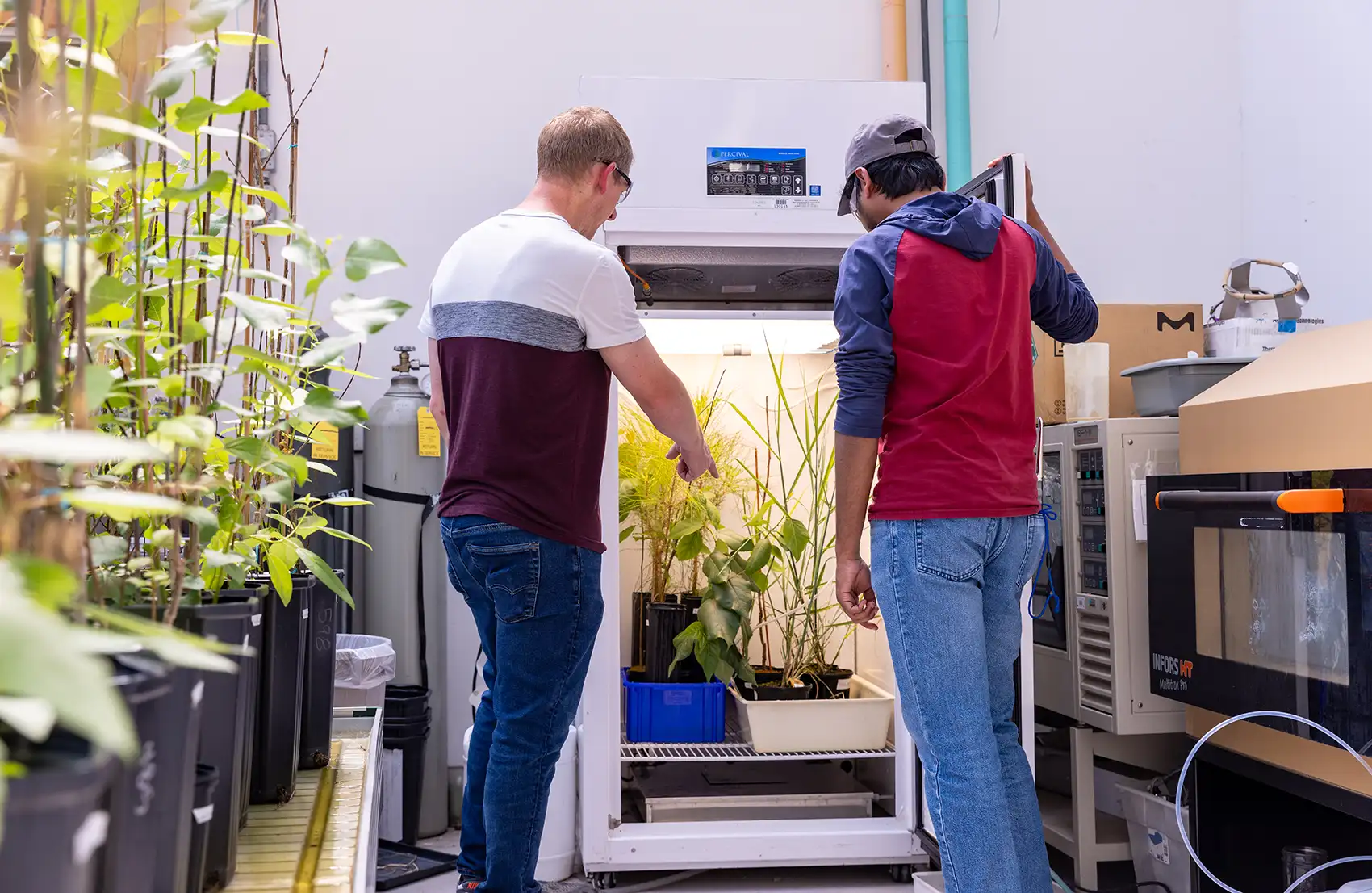
NLR researchers found that despite genetic variation, all tree genotypes within a species, poplar, have virtually identical cell wall architecture.
In other words, said Bennett Addison, NLR’s lead nuclear magnetic resonance (NMR) spectroscopist, “Nature has a universal structural blueprint for the arrangement of polymers within poplar trees. If you’ve found the cellular architecture of one tree sample, you’ve found the architecture of them all.”
To explain, Addison used the example of looking at a neighborhood.
“Imagine driving through a neighborhood where all the houses might use slightly different amounts of drywall, lumber, concrete, or insulation but their blueprint remains essentially the same,” Addison said.
“There are no townhomes, farmhouses, or three-story builds. Every single house uses a ranch-style blueprint. Just like these houses, we found that regardless of genotype, poplar trees do the same thing: Their chemical composition varies, but they all follow the exact same architectural design rules,” he continued.
The finding could speed up discovery in any field that requires a precise understanding of the atomic structures of different materials, such as bioenergy and materials design.
“Nature has a universal structural blueprint for the arrangement of polymers within poplar trees. If you’ve found the cellular architecture of one tree sample, you’ve found the architecture of them all.”
Conserved Cell Wall Architecture Could Streamline Future Research
Many fields, including biochemistry, materials design, and the production of bio-based products, hinge on the ability to deconstruct raw materials into their constituent components then rebuild them into more valuable materials.
But, as Addison explained, it is nearly impossible to deconstruct a material without knowing how it is put together.
“How do you build a composite material if you don’t know how the cells are structured? How do you convert wood into ethylene if you don't know how to access the wood’s components?” he asked. “Part of our goal was to understand how these systems are structured on the atomistic and molecular levels so we can inform biologists, material scientists, and chemists on converting plant cell walls into something useful.”
To create that fundamental understanding, Addison’s team used a technique called solid-state nuclear magnetic resonance spectroscopy, or ssNMR. The technique spins atomic nuclei using strong magnets to create a map of the sample’s atomic structure.
The World's First Macromolecular Model of a Poplar Cell Wall
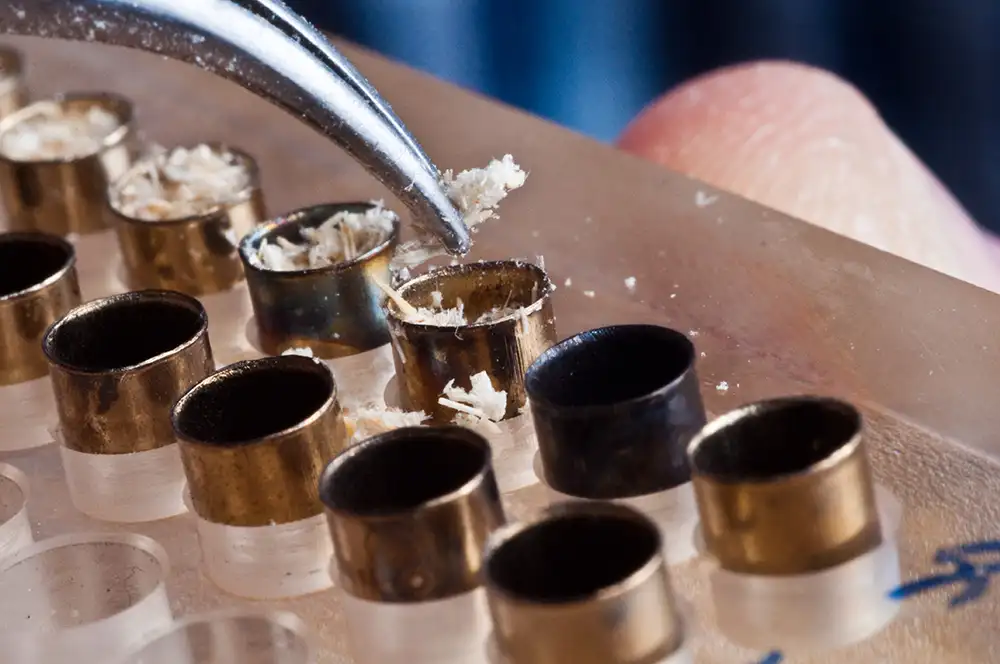
NLR researchers have gone a step further to advance the state-of-the-art of ssNMR research: They created the first experimentally validated macromolecular model of a poplar’s cell wall to help accelerate future bioenergy and materials R&D.
While ssNMR represents the state-of-the-art in cell wall architecture research, ready-made samples are notoriously expensive, running upwards of $5,000 per sample. On the other hand, preparing one’s own samples is both expensive and time consuming: Live plants need to spend weeks breathing isotopically enriched carbon-13 carbon dioxide, which costs about $500 a liter, to produce strong enough signals within the spectrometer. The time and price tag prevent most research teams from preparing or buying more than a sample or two for ssNMR experiments.
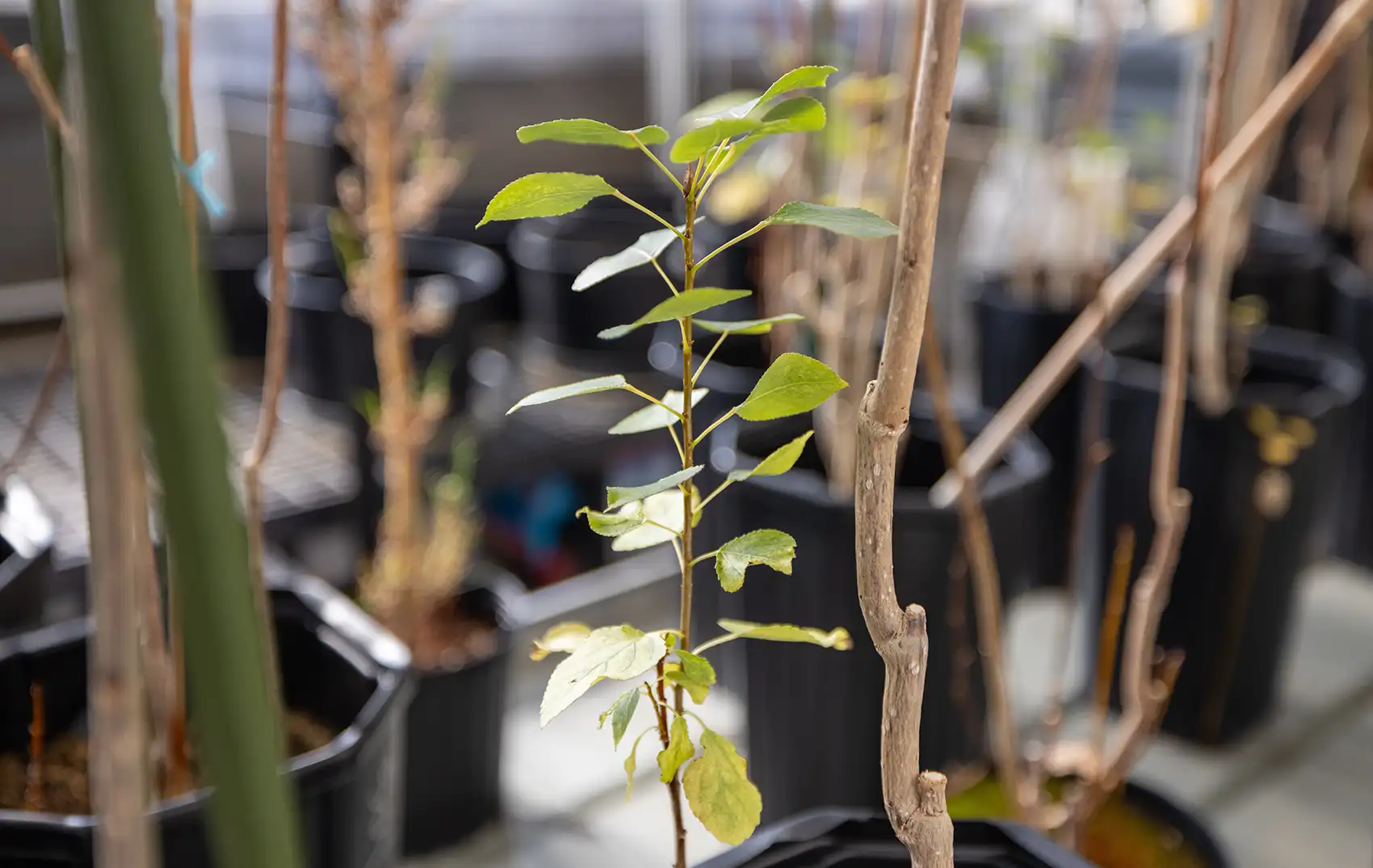
Addison’s team prepared not just one or two samples but 13. They spent six weeks feeding carbon-13 to the saplings within a special greenhouse to create an ssNMR-ready selection that represents the genetic diversity scientists would find in a natural population of hardwoods. Then, researchers studied each sample’s atomic structure.
“Our fundamental finding is that these trees all grow with the same type of polymeric architecture. Their internal architecture is conserved across the species,” Addison said. “Regardless of genotype, they follow the same natural design rules to construct the architecture of their cells.”
Why is that important? Because research teams no longer need to study every tree variation within a population, as Addison’s team did, in an attempt to capture the structural variations of their cell walls. Finding the atomic architecture of just one sample will suffice. That could streamline ssNMR research processes for research teams worldwide, not to mention cutting costs by tens of thousands of dollars per study.
The research has now informed an experimentally validated macromolecular model of a poplar’s cell wall, created by the Center for Bioenergy Innovation and Feedstock Conversion Interface Consortium. It has already been used to simulate pyrolysis of wood.
“It wouldn’t surprise me if the model begins to inform material design for useful materials like composites, films, polymer blends, and fuels,” Addison said—bringing atomic-scale discovery off the benchtop and into the next stage of innovation.
Learn more about NLR’s bioenergy and bioeconomy research, including computational modeling and simulations and analysis, characterization, modeling, and superintelligence research. Partner with NLR to develop, translate, and de-risk bioenergy and biomanufacturing technologies for commercial adoption.
Last Updated April 28, 2026