
NLR Selected To Lead Iron and Steel Technology Incubator
Steel Project Will Establish National Capability for DOE’s Strategy Across Energy-Intensive Industries

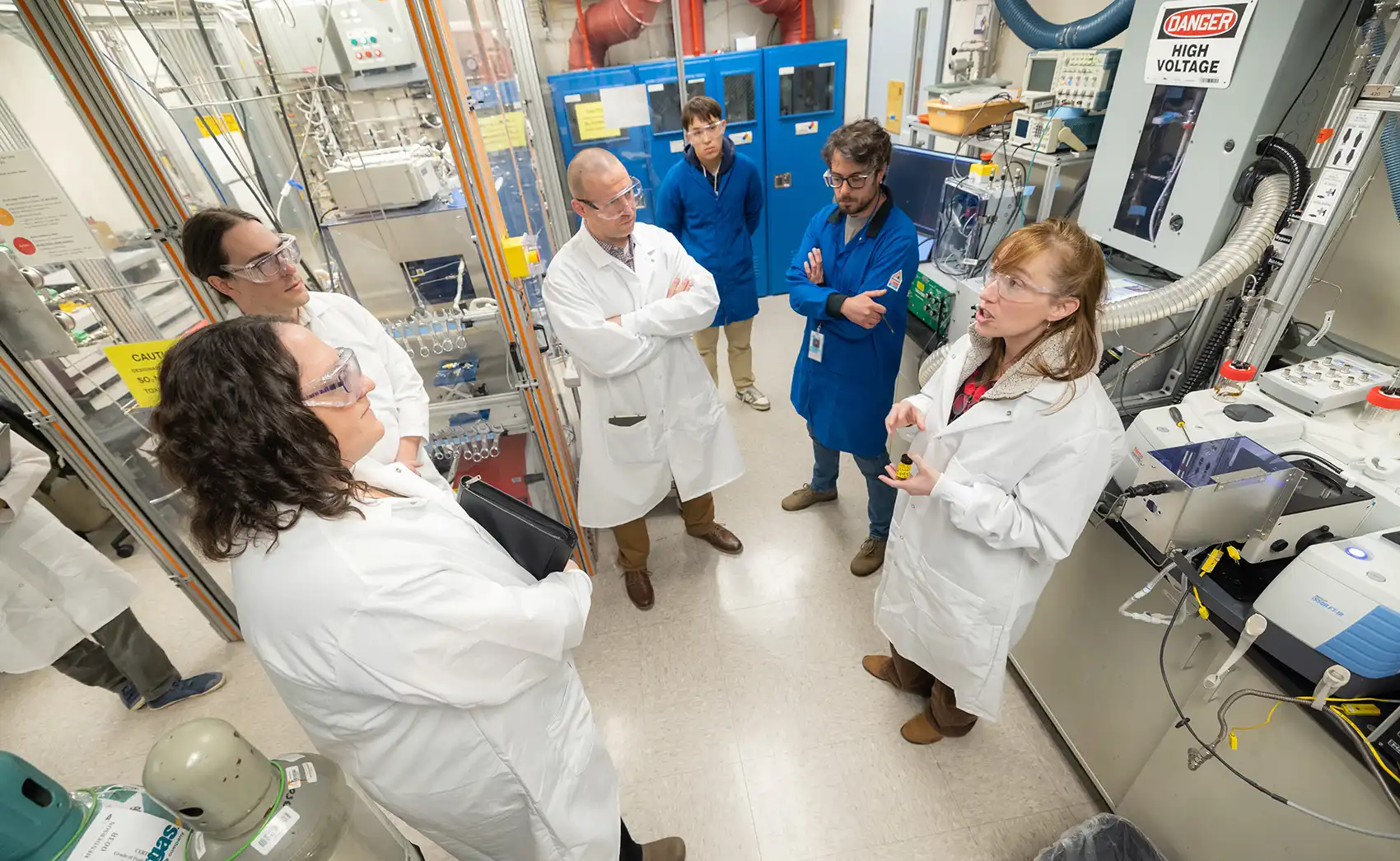
The U.S. Department of Energy’s (DOE’s) Industrial Technologies Office has selected the National Laboratory of the Rockies (NLR) as an incubator to remove detrimental elements impacting U.S. feedstocks used in steel production.
NLR is leading the Tramp Element Removal Innovation (TERI) Center of Excellence, leveraging its recently launched joint research alliance (called the Innovative Materials and Processing for Advanced Critical Technologies, or IMPACT) with the University of Minnesota’s Natural Resources Research Institute. Additional TERI partners include Missouri University of Science and Technology, Colorado School of Mines, Massachusetts Institute of Technology, Hatch Engineering, and DJJ Nucor.
According to the U.S. Geological Survey, approximately 70% of the steel made in the United States uses metallic feedstock composed primarily of recycled scrap metal. Tramp (i.e., unwanted) elements, such as copper, are becoming a larger issue as technologically advanced products enter scrapyards. The contemporary method of addressing tramp elements in scrap is to dilute scrap with more expensive virgin iron; however, this dilution not only adds cost, but also lacks the ability to fully mitigate the impact of the impurities. Innovation in removing tramp metals from the scrap supply is critical to maintaining current trends in domestic steelmaking.
The challenge is significant: Modern internal-combustion vehicles contain more than 40 electric motors spread throughout the vehicle—all connected with copper wires. When vehicles are scrapped, these copper wires and electric motors are mixed in with steel, in ways that are currently impossible to economically remove completely.
TERI combines new and existing capabilities to demonstrate and de-risk tramp element removal technologies, with a focus on copper removal and recovery, which will allow the United States to continue making high-quality steel from its significant scrap metal resources.
Continual input from steel industry stakeholders is an important feature of TERI and helps ensure promising technologies have clear paths for continued scale-up and commercial progression.
“The technologies we select for TERI will be in relatively early stages of development, because there is no mature technology that can completely address the challenge of tramp element contamination,” said Kerry Rippy, NLR’s co-principal investigator for TERI. “But even from that early stage, we're prioritizing industry needs, focusing only on technologies with potentially viable paths to market, and integrating industry insight every step of the way.”
TERI is not only intended to find scalable solutions for steelmaking; its aim is to demonstrate its collaborative process can be replicated with other industries and technologies.
By the project's end, our aspiration is to have a capability that can be leveraged by domestic industry or DOE to mature technologies coming out of universities and other labs up to the correct level,” said Bob Bell, NLR’s co-principal investigator for TERI.
Key Features: Convening Power, Systems Integration, and Industrial Scalability
NLR is convening a panel of industry and academic experts in tramp element removal technologies from across the United States to help select early-stage technologies for development and identify key capabilities to support continued innovation in this space. The most promising technologies will show technical and economic viability and have broad industry appeal.
NLR’s systems integration expertise is critical to this kind of work. For example, any mechanism that is used to remove copper from steel is inevitably going to change the series of steps for processing scrap steel in some way.
“What we hope is that whatever effects our technologies have on current scrap processing methods, they don’t detrimentally impact the following downstream steel processes negatively,” Bell noted. “If we identify a technology that can make it easier to remove copper, we need to consider whether that will make processing the rest of the steel more expensive. In some cases, our technologies could even have secondary benefits that make the rest of the process less expensive. For example, if we pull out some sulfur as well, that might lower the cost of desulfurization. That would be the ideal case.”
Finding solutions that integrate into existing systems has been an NLR capability for many decades.
“I’ve been to steel plants where they are moving hundreds of tons of steel hooked from above on huge gantries spanning the length of football fields,” Bell said. “TERI solutions need to readily integrate into these types of existing processing chains, which is why it’s so important to have industry partners involved.”
NLR will demonstrate mature technologies capable of processing at a bench scale (a few kilograms) inside its Energy Materials and Processing at Scale facility and then send them to the Natural Resources Research Institute, which has facilities that can demonstrate larger-scale output (hundreds of kilograms). This final, scalability demonstration step in the TERI project helps ensure these technologies are positioned to improve the efficiency and competitiveness of the American steelmaking industry.
This effort is part of a broader NLR initiative to ensure competitive production of base metals. Learn more about NLR’s advanced manufacturing and materials science research capabilities.
Last Updated April 28, 2026