
Where Marine Energy Meets Hybrid Power Systems, This Laboratory De-Risks Integration
ARIES Platform Has Essential Capabilities To Emulate and De-Risk Marine Energy Systems for Range of Applications

Energy from ocean waves has the potential to power offshore and coastal microgrids for applications like recharging autonomous underwater vehicles, supporting ocean sensors and aquaculture, and securing local power for remote communities.
But to harness that energy requires wave energy converters interconnected with a range of storage and hybrid generation assets, which are nascent technologies. Between the risks of untested electronics and the unforgiving environments of many microgrids, the rollout of marine energy technologies must be precise. That is where the Advanced Research on Integrated Energy Systems (ARIES) platform’s unique capabilities for validation and de-risking become essential.
Operated by the National Laboratory of the Rockies (NLR), ARIES integrates key system components in the lab such as power systems, water power technologies, power electronics, and emulated ocean physics. With the ARIES setup, communities, companies, and research groups can simulate device performance before submerging them in the water, confirming their long-term payoff and technical success.
“ARIES enables NLR and partners to validate and refine complex hybrid marine energy systems in a controlled, repeatable, and accessible environment,” said Al LiVecchi, NLR water power laboratory program manager. “This helps de-risk and ready systems for ocean deployments and accelerate technology development. There isn’t a marine energy company which has leveraged NLR’s laboratory infrastructure who hasn’t incorporated the learnings in next-generation systems.”
Waves in the Lab—Oceanic and Electronic
Microgrids can support a wide range of offshore and remote applications. Logistically, power supply to coastal sites can be strained by distance, creating security and reliability risks.
That concern extends to offshore missions such as ocean sensing and aquaculture as well as to distant U.S. military bases, isolated Tribal villages, and remote mining and fishing industries. Power from the grid is not always a given—so, for some communities, it might make sense to look to the ocean for energy. But first, that energy source can be tested with ARIES.
“For cutting-edge ocean energy solutions, it can be hard to feel confident about deploying new technologies when there are so many unknowns,” said Jen Kurtz, ARIES research director at NLR. “ARIES removes uncertainty and reduces risk. We create the marine and power system environment that partners expect to face, as close to real as possible.”
To replicate complicated systems that integrate marine energy with hybrid power systems, ARIES uses both custom hardware and digital twins.
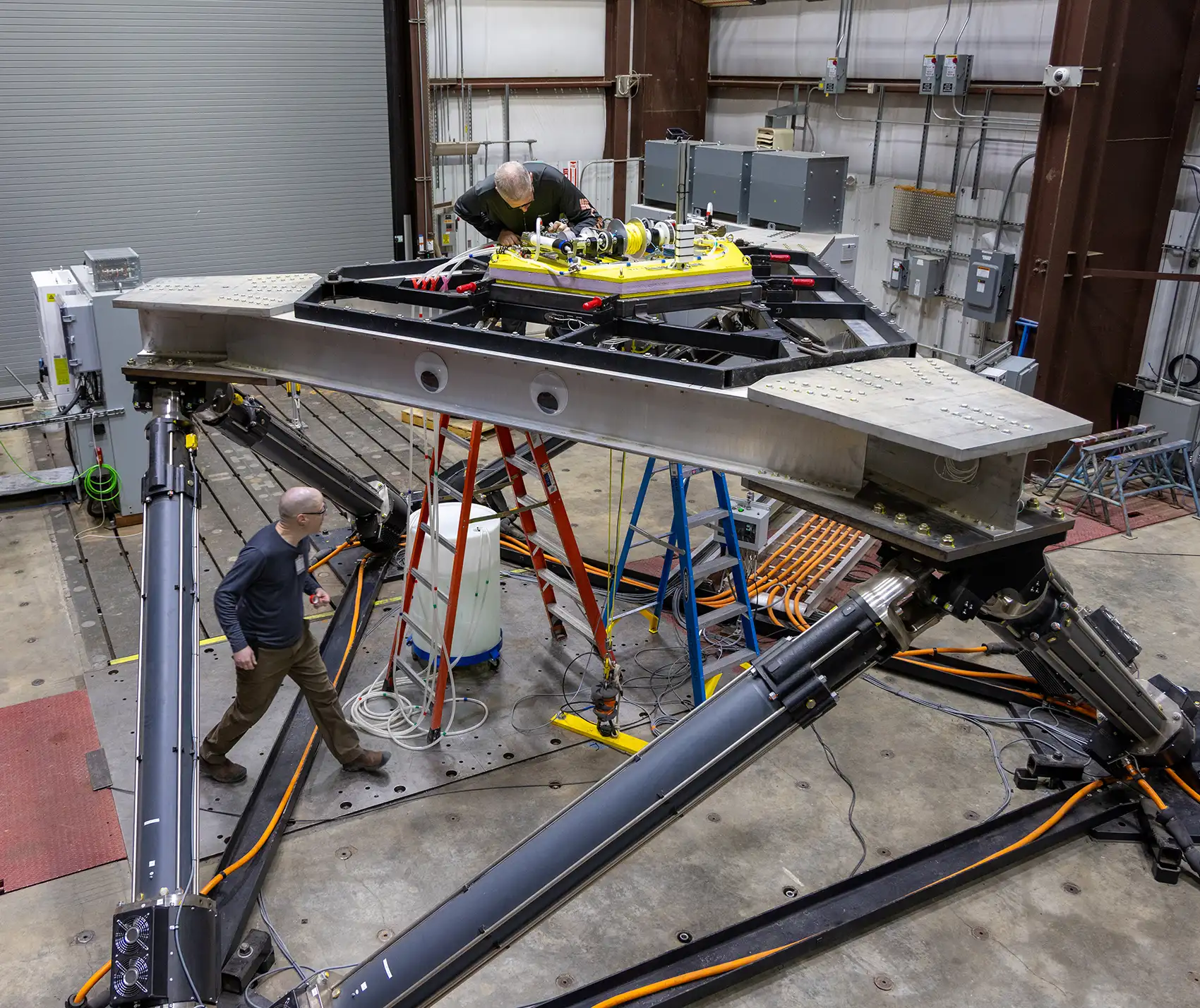
One central tool is a dry simulator of ocean waves that moves devices like swells in the ocean do. The large-amplitude motion platform, or LAMP, is designed to move 10,000-kilogram wave energy converters across six degrees of freedom. LAMP tests the physical resistance of devices to the throes of the ocean and measures their multiangle energy-capture ability. NLR researchers have exhaustively characterized LAMP so that wave properties are reflected exactly.
As LAMP undulates like an ocean, the rest of ARIES replicates grid integration. Devices under test are linked to a comprehensive set of research power system emulators and their cyber communications. ARIES replicates any power system, and, for additional fidelity, it engages a range of on-site power resources.
ARIES Evaluates Marine Energy:
- Power electronics design and controls
- Marine energy control development for optimal microgrid integration
- System integration prior to deployment
- Model validation
- Device characterization
“The cyber-physical resources at ARIES are exceptional and always expanding,” Kurtz said. “Whatever the nature of partner power systems—whether they are connecting to electrolyzers, batteries, responsive loads—we ensure that ARIES can emulate it. This is how we are able to capture the deep details of marine energy integration.”
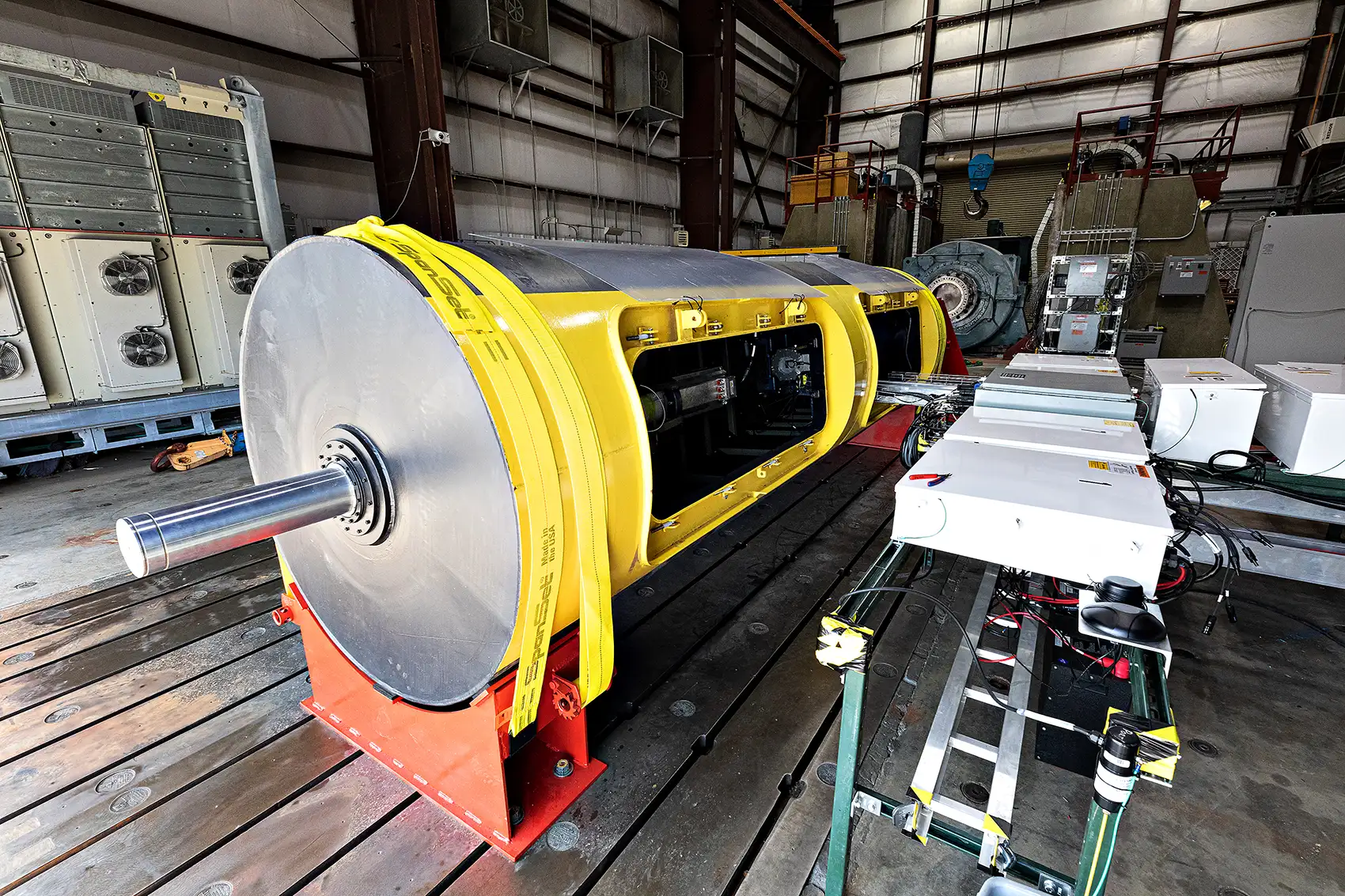
LAMP is suitable for many wave energy converters, and dynamometers at NLR’s Flatirons Campus provide a complementary capability for validating power take-off systems. Instead of recreating the dimensional forces of water, they produce the rotation that drives electrical generation. This is how ARIES researchers studied the SeaRAY Autonomous Offshore Power System. By generating the same power that the device produces offshore, the ARIES team could test microgrid and nanogrid configurations for applications such as underwater vehicle charging.
The ARIES dynamometer, LAMP, and grid emulators are useful for testing power take-off for both rotary and linear generators, running the gamut of wave, tidal, and river current devices. Any wave or hydrokinetic microgrid configuration is on the table, and partners are invited to take advantage.
Versatility for Marine Energy and Hybrid Power Systems
Across U.S. coastlines and scattered throughout U.S. islands and archipelagos, there are hundreds of microgrids with limited or no connection to the main grid. For communities and companies considering microgrid power from marine energy, power electronics are an important part of the equation.
Power electronics convert and filter electricity to be reliably used by the grid. Wave energy, for example, sends varying and unsteady power to land, which complicates the grid’s ability to use that power. Electronics with suitable controls and hardware are required to convert that raw power into usable electricity. That interface of onshore and in-water resources is a focus at ARIES.
An example of power electronics validation is the hydraulic and electric reverse osmosis wave energy converter, or HERO WEC, project in which NLR used ARIES to validate a wave energydevice integrated with simulated grid assets. The researchers developed a charge controller to better manage energy flow between the offshore generator and the onshore battery. In validating that charge controller, the researchers updated ARIES to handle future validations quickly, flexibly, and at high fidelity.
Get Involved
To dive deeper into hydrokinetic and marine energy microgrids, NLR launched a series of webinars in 2026 focused on the challenges of integrating marine energy technologies into remote, islanded microgrids, including how ARIES can be applied to real-world microgrids. The webinar series also pertains to participants in related U.S. Department of Energy programs, such as the Community Microgrid Assistance Partnership and the Energy Technology Innovation Partnership Project, among others.
Learn more about the ARIES platform and LAMP. To partner with us, contact Rebecca.Fao@nlr.gov.
Last Updated April 28, 2026