
Field Characterization Tools
NLR's optical measurement tools meet the needs of concentrating solar thermal (CST) plants in the field, characterizing heliostats and parabolic troughs on the ground and from the air.
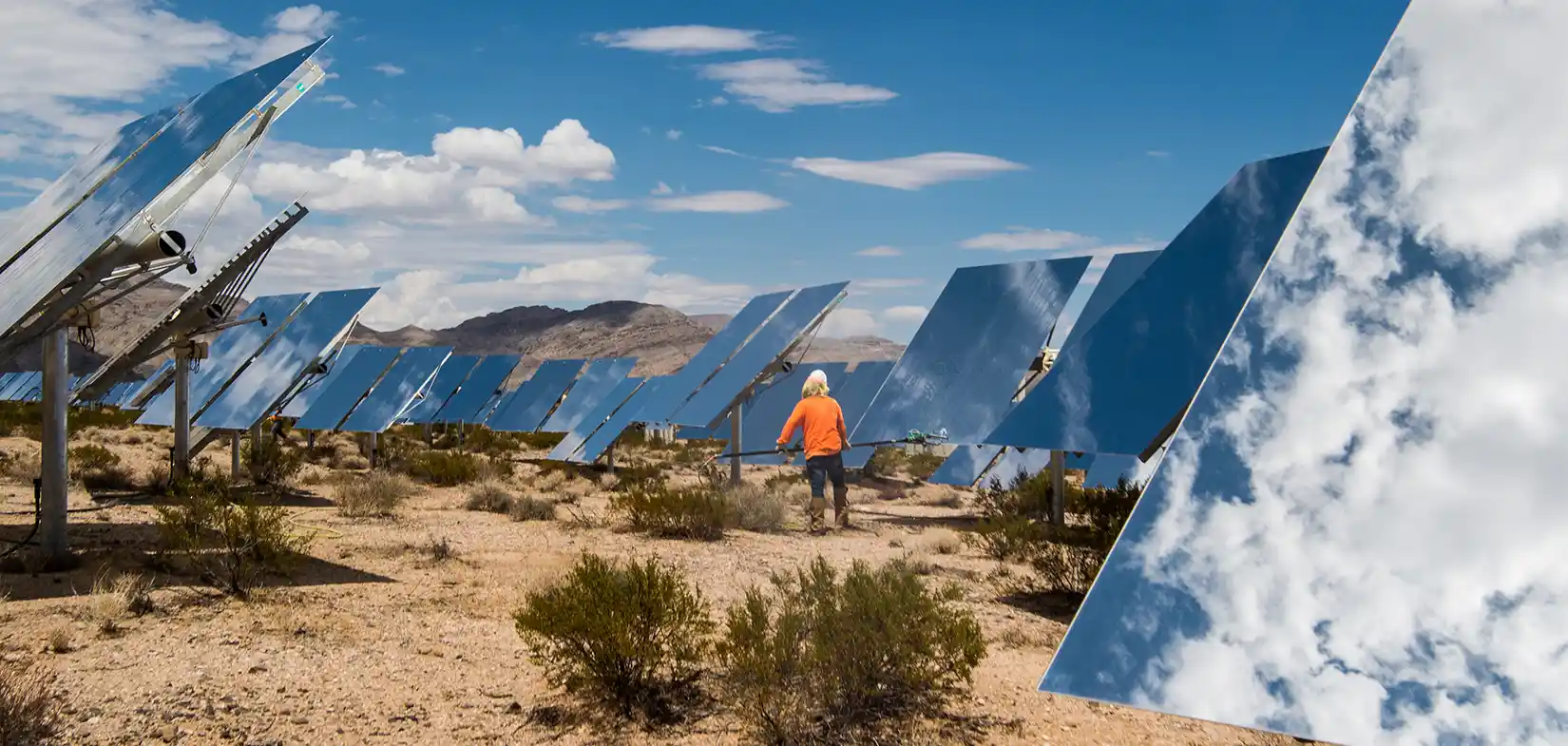
Heliostats at the Ivanpah Solar Project in California.
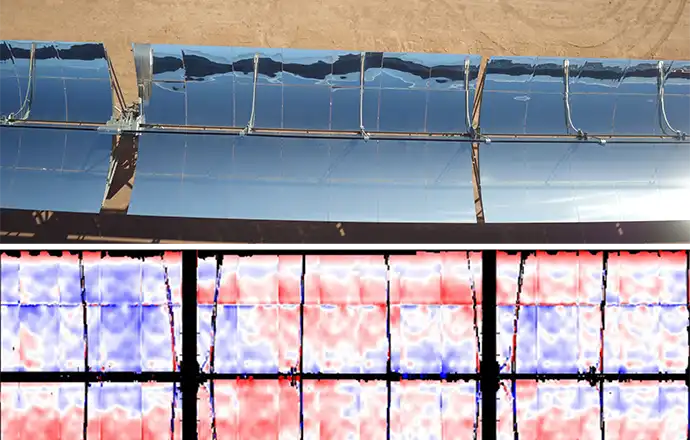
Distant Observer Uncrewed Aerial System
Distant Observer is a system to assess the optical quality of parabolic trough solar collectors by quickly measuring mirror slope and receiver positional errors from an uncrewed aerial system (UAS). Computer vision and deep learning methods have been implemented to automate this tool, and over 100 trough modules have been analyzed at operating solar thermal plants.
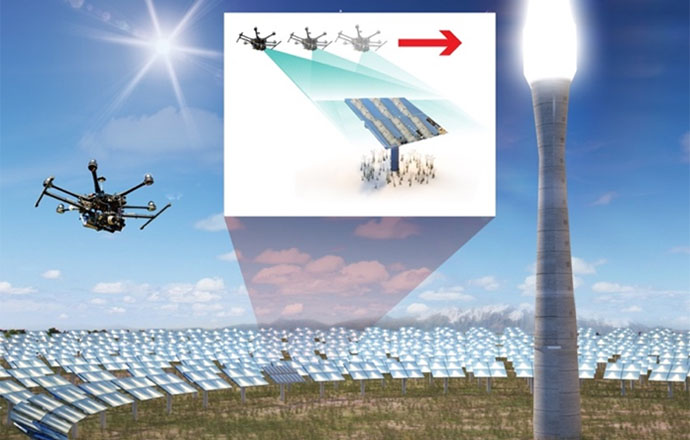
Non-Intrusive Optical Tools
Non-intrusive optical (NIO) technology estimates heliostat slope, canting, and tracking errors using UAS imaging. Pre-programmed flight paths efficiently capture the central power tower's reflection panning across each heliostat. These images are processed to provide useful information about heliostat performance, optical errors, and potential corrections to CST plant operators.
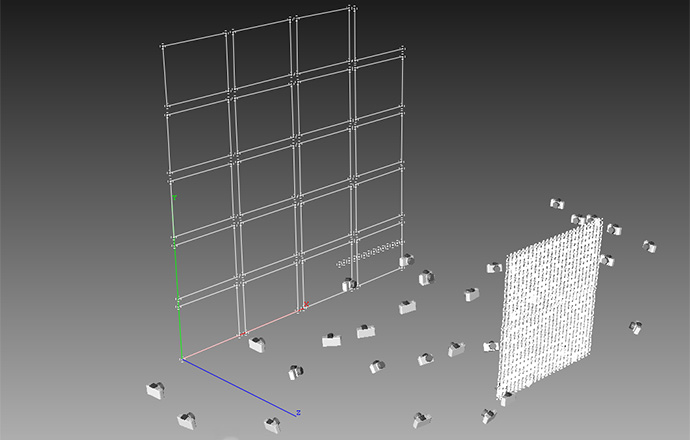
Photogrammetry Tools
NLR uses a variety of commercial and custom photogrammetry tools to assess the shape and alignment of large solar collectors. Adhesive fiducial markers are affixed to the mirror surface, imaged with a calibrated camera, and identified automatically in each image. These methods have been used to assess the shape of heliostats and facets from less than 1m2 to over 25m2.
Reflected Target Nonintrusive Assessment Optical System
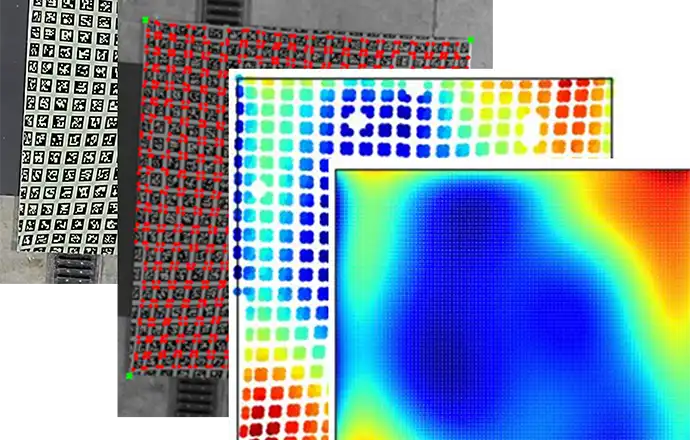
Reflected Target Non-Intrusive Assessment (ReTNA) is a lightweight, low-cost, and flexible optical system that uses images of reflected computer vision markers to measure heliostat surface shape. Using reflected markers allows for 2D surface slope measurement from a single image, automatic surface shape calibration of the target, and stitching of results from multiple images to measure large surfaces in any lighting. ReTNA has been used to measure transient temperature effects in the laboratory, heliostat quality during manufacturing and assembly, and outdoors in operating solar fields.
Facility and Laboratory Equipment
UAS (drones) for photography and video
Ultra-Accelerated Weathering System
Advanced Optical Materials Laboratory
Publications
Improvements in Optical Surface Measurement Using Reflected Computer Vision Targets, NLR Presentation (2024)
A Combined Computer Vision and Deep Learning Approach for Rapid Drone-Based Optical Characterization of Parabolic Troughs, Journal of Solar Engineering (2023)
Improvements in Reflected Target Non-Intrusive Assessment (ReTNA), U.S. Department of Energy Heliostat Consortium for Concentrating Solar Power Presentation (2023)
A New Reflected Target Optical Assessment System - Stage 1 Development Results, NLR Conference Paper (2023)
A Non-Intrusive Optical Approach to Characterize Heliostats in Utility-Scale Power Tower Plants: Flight Path Generation/Optimization of Unmanned Aerial Systems, Solar Energy (2021)
A Non-Intrusive Optical (NIO) Approach to Characterize Heliostats in Utility-Scale Power Tower Plants: Methodology and in-situ Validation, Solar Energy (2020)
A Non-Intrusive Optical (NIO) Approach to Characterize Heliostats in Utility-Scale Power Tower Plants: Sensitivity Study, Solar Energy (2020)
Contact
Share

Last Updated May 13, 2026